
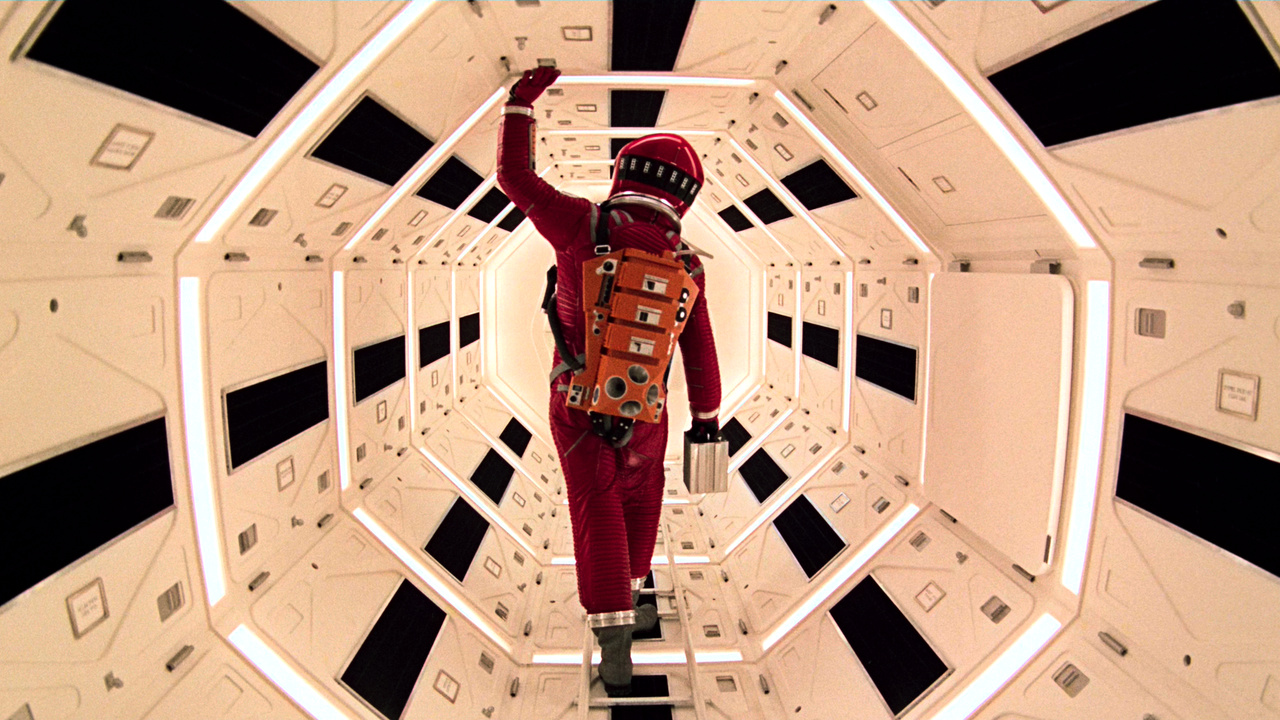
As part of a university project in my Bachelor’s degree, I and two fellow students re-soundtracked an iconic scene from Stanley Kubrick’s ‘2001: A Space Odyssey’. Due to copyright this scene cannot be published, but is available in Google Drive via the link below:
https://drive.google.com/file/d/1X4cwm5rQiDiwxGTufS0faESeuLMNMqmp/view?usp=sharing
Spaceship & Pod Ambience
For this project, the priority was to immerse the viewer in a realistic sonic environment. One would expect to hear some constant noise on a spaceship due to life support and ship control systems. Using Ableton’s wavetable synthesizer, I produced an evolving waveform from the two modulating oscillators shown below:
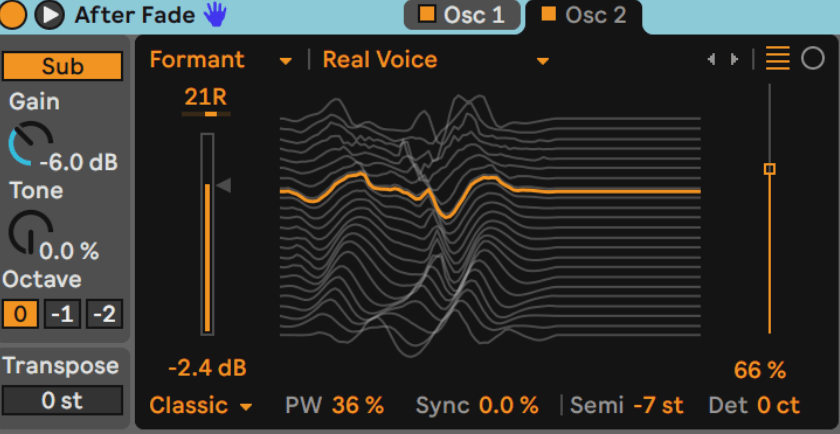
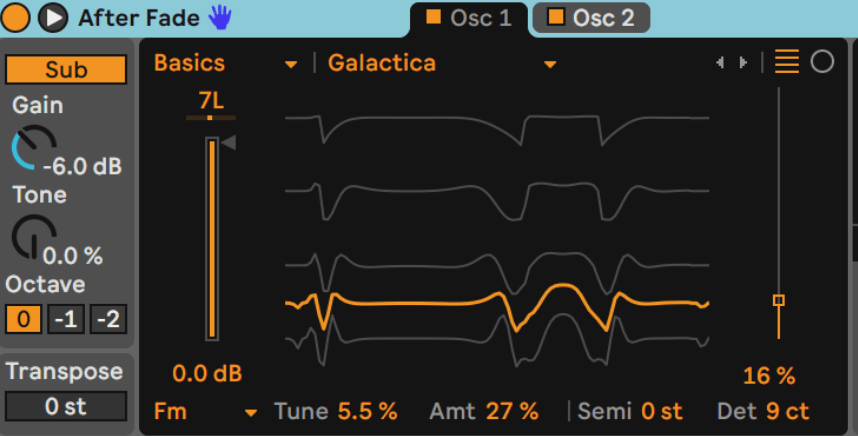
To give the waveform an atonal, machine-like-rumble sound, I recorded a minute long clip of two of the waveforms oscillating one semi-tone apart, as shown:

This atonality keeps the oscillators musically neutral, leaving scope for music to be added without potential tonal clashes.
I exported the minute long clip as a .wav file and resampled it in Ableton’s Simpler to produce two identical waveforms differing slightly in pitch. Since resonant frequencies of smaller bodies are higher than those of larger bodies, higher frequencies within signals conveyed through smaller bodies are likely to dominate relative to lower frequencies. For this reason, I decided that the noise on the main ship and the pod should differ in pitch; the pod being higher pitched due to its smaller body. Syncing these sounds to be present in their respective locations provides a continuity between audio and video; as the location of the scene changes, so does the background audio.
Perceived Silence
Given the objective to immerse the viewer in a realistic sonic environment, the sections of the scene outside of both ships in the vacuum of space should be silent. However, total silence provided no emphasis to the dark, emptiness of space as depicted in the scene and detracted from the dramatic suspense of the unfolding events. Some audio was therefore necessary to emphasise the atmosphere, whilst still being perceived as silence. For the sake of continuity, I decided to use the same waveform as used for the background noise in the ships. I applied Logic’s equaliser audio unit to the waveform to reduce the higher frequency presence, so as to become an LFO, and applied a sub-bass audio unit to lower the frequency to a minimal perceivable level. This was inspired by a similar effect implemented in Alfonso Cuarón’s ‘Gravity’; using LFOs to give an impression of absence of sound, whilst maintaining an ambience. This technique is referred to as perceived silence. Traditionally in cinema, silences had been difficult to achieve due to the constant sound of the film projector. Although today this issue is no longer prevalent, a typical cinema audience will always give rise to some noise, referred to as ‘popcorn sound’. Implementing some audio as perceived silence reduces the impact that this ‘popcorn sound’ has on an audience’s audible experience.
To add to the hectic cacophony of sound just before Dave evacuates the pod, I found samples of various siren tones from Splice (an online royalty free sample library). I then positioned them in the timeline so as to provide an audible response to Dave’s interaction with his control panel.
 grunfeldaudio.productions