
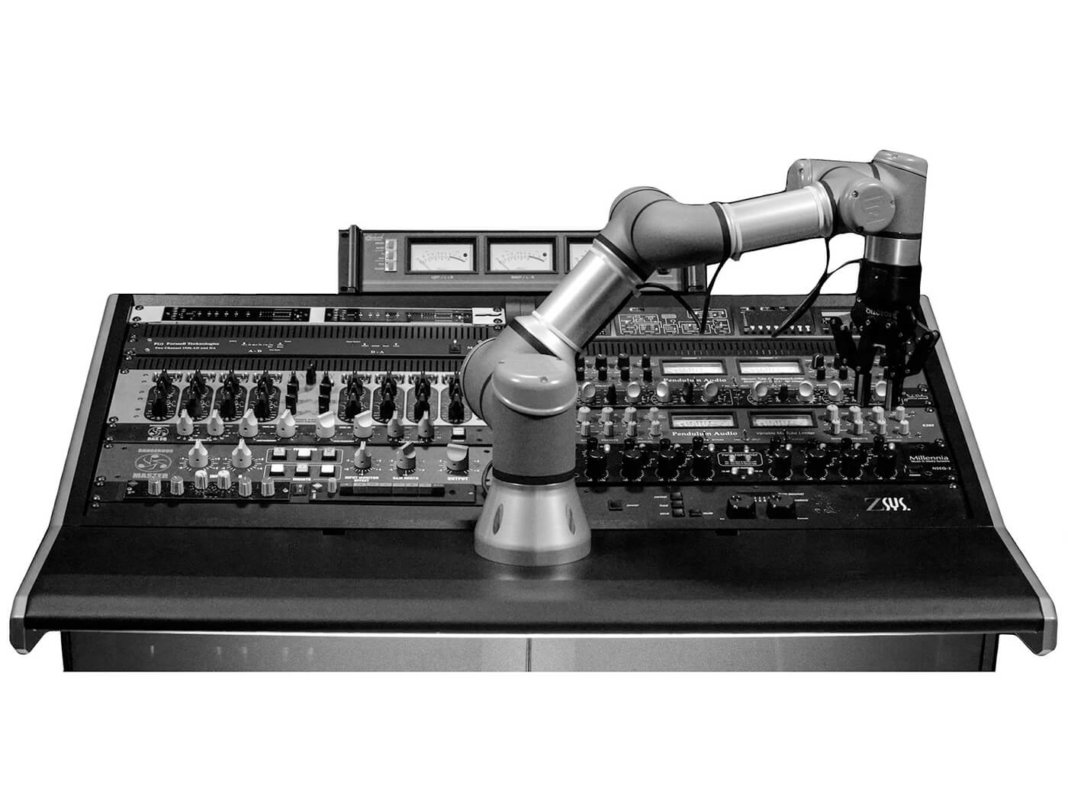
Mastering is the final step in audio post production; balancing out all the elements of a track so it sounds consistent across all platforms. Historically, this has been conducted by a mastering engineer, blending science and personal taste to produce a cohesive, balanced final piece. Due to the critical listening required, and depending on the engineer’s experience, mastering can often be time consuming, and expensive.
In recent years, the development of automated mastering services has enabled artists with smaller budgets to access professional sounding masters without the need to pay for human engineers.
LANDR is a cloud-based music creation platform developed by MixGenius (an AI company based in Montreal). It’s flagship product is its automated mastering service, first launched in 2014. This product remains in constant development, through evolving AI, and its current iteration uses Synapse, the most sophisticated AI mastering engine yet:
“With years of research, 19 million mastered tracks and over 1 million hours of music, Synapse is the most sophisticated AI-powered mastering engine yet. Improved clarity, smarter compression and superior loudness give your music instant, professional polish at a price that works for your budget.”

CloudBounce is another automated online mastering service, founded in 2015, and is a product of the Abbey Road Red Program. CloudBounce boasts one of the most advanced machine listening algorithms, and employs different audio processing tools such as a compressor, EQ, limiter and stereo imaging “to make it sound powerful and crystal clear”.
Ozone is iZotope’s one-stop-shop plug-in for mastering music. It applies integrated machine learning along with extensive user inputs and customisation to produce industry standard masters to the artist’s preference.
iZotope’s latest iteration, Ozone 9, isn’t a solitary, simple plug-in, but rather a full suite of various tools typically present in a mastering studio.
The Future of Mastering
In the end, the future of mastering comes down to the musician. Different musicians may prioritise different things when it comes to obtaining a master. One of the most significant factors is turnaround time. With an automated mastering engine, a master of an individual track can be completed in 5-10 minutes. On the other hand, a manual master, done by a mastering engineer, can take anything from a few hours up to a few days.
Another significant factor is the personalisation and customisation of the master. With a human engineer, the artist can discuss their specifications and provide some creative input. Although some tailoring options are available, automated mastering services do not currently provide the same level of customisation. It is however worth noting that as more tracks are mastered using automated services, the machine learning algorithms governing said services become more experienced, and thus learn to improve. They work very similarly to humans; the more experience they have, the better they get. It is therefore a certainty that automated mastering services will improve.
Finally, one must consider the price: with online mastering, you typically pay monthly or annually to access the service, giving you a certain number of masters or even an unlimited amount within that timeframe. With LANDR, you can pay $25 per month for an unlimited number of mastered versions of your tracks. On the other hand, a studio based Mastering Engineer will typically charge $20 to $100 per track (excluding the top notch engineers who charge a significant premium).
At the end of the day, both are feasible options for obtaining masters, and there is no right or wrong. I think there is a future in both!
 grunfeldaudio.productions